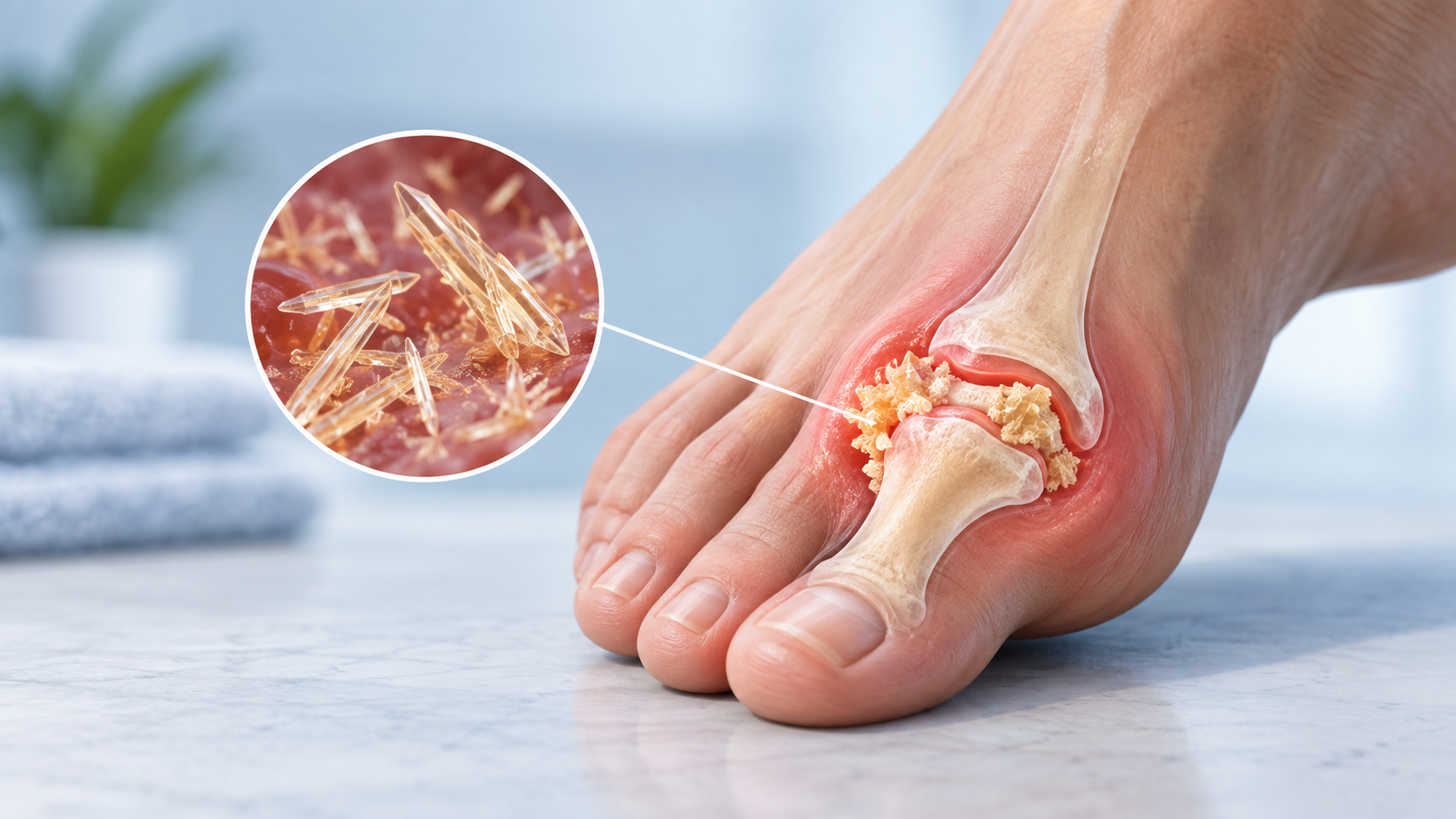
Gout is a form of inflammatory arthritis caused by monosodium urate crystals forming in and around joints. Those crystals develop when serum urate stays high enough for long enough.
The painful attack is the immune system reacting to crystals. The underlying disease is the crystal deposition itself.
Where does uric acid come from?
Uric acid is produced when the body breaks down purines, which come from normal cell turnover as well as food. Most urate is cleared through the kidneys, with some also handled through the gut. In many people with gout, the main problem is not that the body makes extraordinary amounts of uric acid but that it does not clear it efficiently enough.
Why do some people get gout and others do not?
Genetics has a major role. Kidney disease, excess body weight, some medicines, alcohol, certain dietary patterns and other health conditions can also affect urate or flare risk. Diet matters, but gout is not simply the result of eating badly.
What does a gout flare feel like?
A flare typically causes rapidly developing severe pain, swelling, warmth and redness. The big toe is classic, but ankles, knees, wrists, fingers and other joints can be affected. A new hot, swollen joint can also be caused by infection or another arthritis, so first or unusual attacks deserve medical assessment.
Why does gout keep coming back?
If urate crystals remain after the pain settles, another flare can occur. Over time, untreated gout can lead to tophi, chronic inflammation and joint damage.
Can the crystals go away?
Yes. When serum urate is kept below target for long enough, existing deposits can gradually dissolve. Major rheumatology guidance in the US, UK and Australia centers long-term treatment on sustained urate lowering when it is indicated.
Is gout the same everywhere?
The biology is the same, but terminology, laboratory units, medicine availability and treatment pathways vary by country. This site uses evidence from multiple systems, including the American College of Rheumatology, NICE in the UK, Australian rheumatology resources, Kenyan national clinical guidance and peer-reviewed studies.
This article is educational and is not a substitute for individualized medical care.
Sources
- American College of Rheumatology: 2020 Gout Guideline
- NICE NG219
- Arthritis Australia: What about gout?
- Kenya Ministry of Health Clinical Guidelines 2024
Related guides
- Gout symptoms and early signs
- How gout is diagnosed
- How to prevent future gout attacks
- Is gout curable? What long-term control means
- Gout, kidney disease and kidney stones
- Gout, high blood pressure and heart disease
- Living with gout: sleep, work and mobility
- Exercise and gout
Evidence checked September 2026.