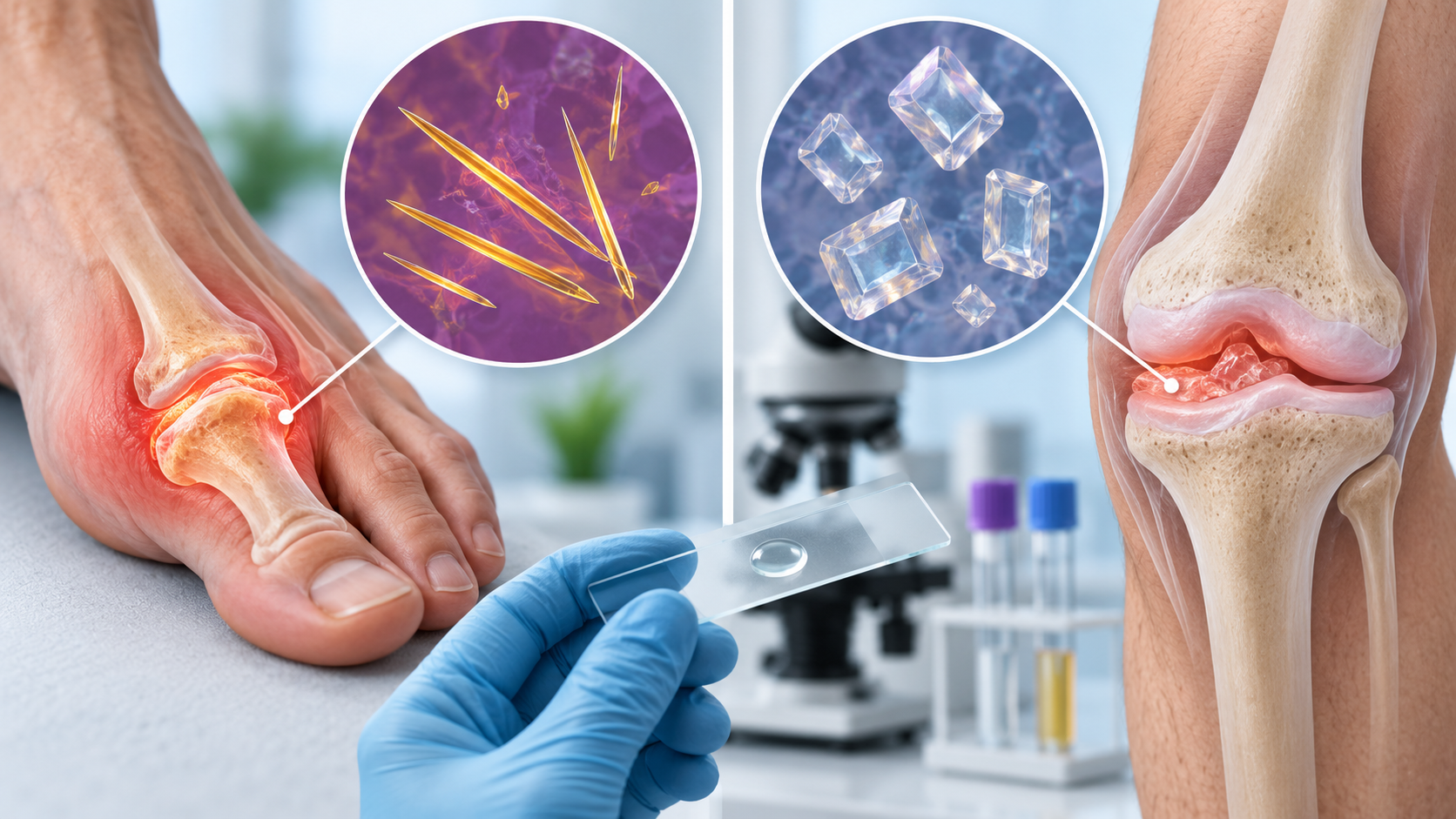
Gout and pseudogout can both cause sudden, very painful, swollen joints, but they are not the same disease. When the distinction matters clinically, joint-fluid testing and other diagnostic tools can separate the crystal types. For another common look-alike, see gout vs. rheumatoid arthritis and other arthritis.
The crystals are different
Gout is caused by monosodium urate crystals. Pseudogout, now often called calcium pyrophosphate deposition disease (CPPD), is caused by calcium pyrophosphate crystals.
Which joints are typical?
Gout often starts in the big toe, ankle or midfoot, although knees, wrists, fingers and other joints can be involved. CPPD commonly affects the knee and wrist, but there is plenty of overlap.
Do symptoms feel different?
Not reliably. Both can cause rapid-onset pain, swelling, warmth and redness. The clinical pattern may suggest one condition, but symptoms alone cannot always separate them.
How are they distinguished?
Joint-fluid microscopy is the clearest way to distinguish them when the diagnosis is uncertain because the crystals look different under polarized light. Imaging can also support the diagnosis.
Does uric acid help?
Serum urate can support a gout diagnosis, but it does not diagnose CPPD and it cannot by itself prove that a painful joint is gout.
Why the distinction matters
Acute anti-inflammatory treatments can overlap, but long-term urate-lowering therapy treats gout, not CPPD. Getting the diagnosis right prevents years of treating the wrong underlying problem.
This article is educational and is not a substitute for medical advice.
Sources
Related guide: Gout or Something Else? Conditions That Can Look Like Gout compares CPPD with infection, injuries and other conditions that can resemble gout.
Evidence checked September 2026.