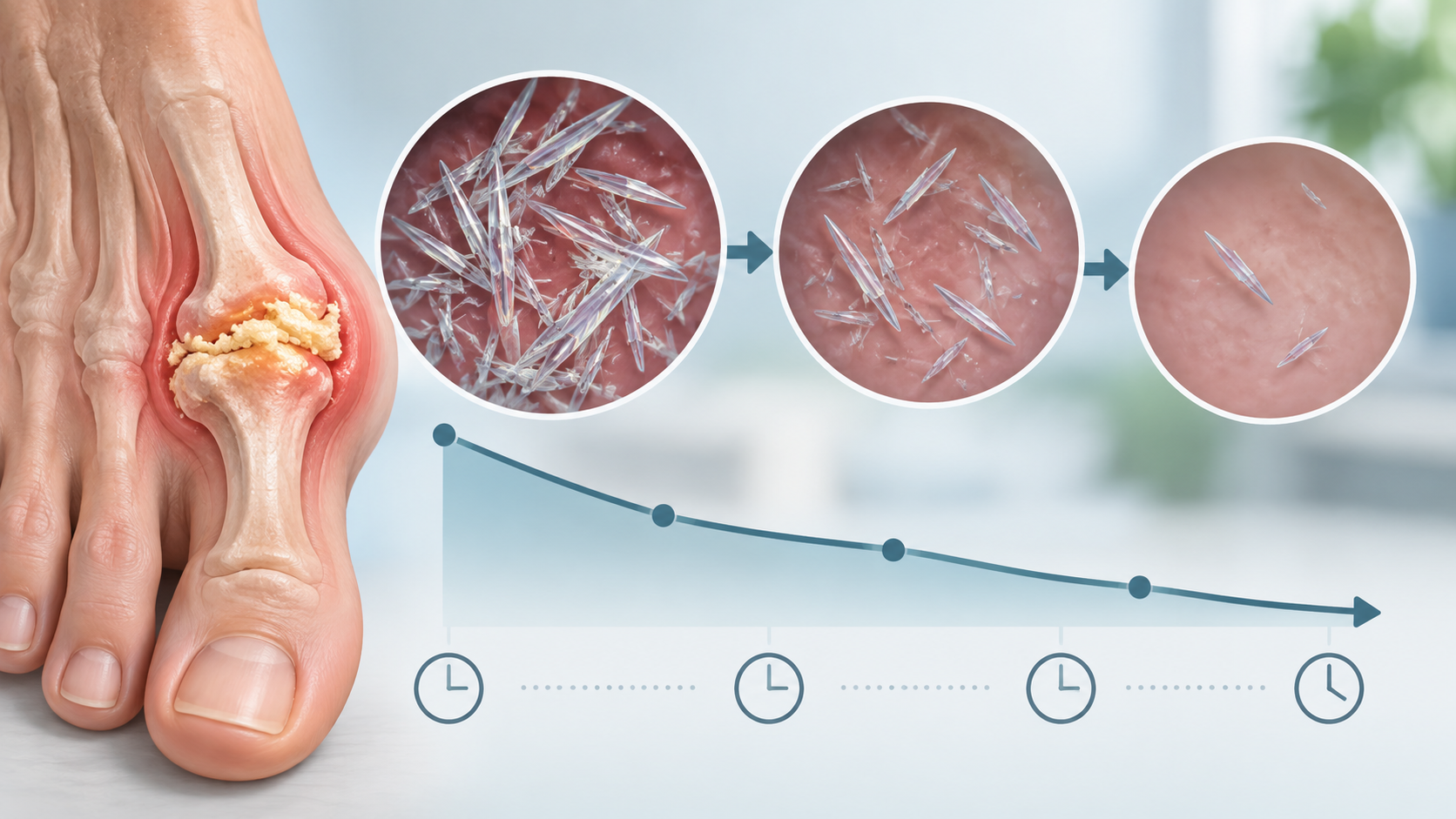
Short answer: gout crystals can dissolve, but they usually do so gradually over months to years once blood urate is kept below the level that allows monosodium urate crystals to persist. There is no drink, cleanse, massage, or supplement proven to dissolve gout crystals quickly.
The key is sustained urate lowering. Our guide to urate-lowering therapy and treat-to-target care explains how clinicians use repeated urate measurements, and the home uric-acid testing guide explains where home monitoring can fit between visits. The American College of Rheumatology describes a treatment goal of serum urate at or below 6 mg/dL for people receiving urate-lowering therapy. NICE similarly recommends a treat-to-target approach, generally below 6 mg/dL, and says a lower target below 5 mg/dL may be considered for people with tophi, chronic gouty arthritis, or frequent flares.
How fast do crystals actually disappear?
There is no single timetable because crystal burden and serum urate levels differ from person to person. Imaging studies show that crystal deposits can shrink substantially during the first year of successful urate-lowering treatment and can continue to decline over subsequent years.
A 2025 prospective study following people with gout for 24 months found large reductions in tophus volume during treat-to-target therapy. Other dual-energy CT studies have found continuing reductions in urate deposits over one and two years. The lower the sustained serum urate level, the faster crystal deposits tend to resolve.
That means a person who has had gout for years or has large tophi should expect crystal clearance to take longer than someone with a smaller crystal burden.
Can crystals dissolve even if you still get flares?
Yes. Paradoxically, gout flares can temporarily become more common when urate-lowering therapy is started or intensified. As existing crystal deposits begin to change, they can provoke inflammation. This is why clinicians often use flare-prevention medication such as low-dose colchicine or an NSAID for a period when urate-lowering therapy is started.
A flare during the early months of treatment does not necessarily mean the urate-lowering treatment is failing.
What actually dissolves gout crystals?
The scientifically supported approach is to keep serum urate low enough, consistently enough, that existing monosodium urate deposits gradually dissolve. Common urate-lowering medications include allopurinol and febuxostat; other treatments may be used depending on the person and severity of gout.
Diet, hydration, weight management, and limiting excessive alcohol can support overall gout management, but current guidelines do not support claims that a specific food, juice, vinegar, herb, supplement, or detox regimen can rapidly dissolve established gout crystals.
What about tart cherry or other supplements?
Some supplements and foods have legitimate research behind them, but that evidence needs to be described carefully. Tart cherry is a good example: studies suggest it may have modest effects on serum urate or flare risk, but results are inconsistent and it has not been shown to replace standard urate-lowering therapy or reliably dissolve established crystal deposits.
We discuss supplements on this site when there is credible evidence, but we distinguish between an interesting adjunct and a proven treatment.
When should you talk with a clinician?
If you have recurrent gout attacks, tophi, kidney disease, kidney stones, or persistently elevated urate, it is worth discussing a treat-to-target urate-lowering plan with a clinician. Do not stop prescribed urate-lowering medication during a flare unless your clinician specifically tells you to.
This article is educational and is not a substitute for individualized medical advice.
Sources
- American College of Rheumatology: Gout
- NICE NG219: Gout—diagnosis and management
- GOUT-DECTUS study: tophus resolution during 24 months of treat-to-target therapy
- NOR-Gout: two-year reduction of urate deposits on dual-energy CT
Evidence checked September 2026.